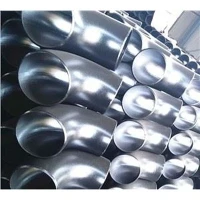
Hey there! As a supplier of carbon steel elbows, I often get asked about the differences between seamless and welded carbon steel elbows. It's a pretty common question, and it's important to understand these differences if you're in the market for carbon steel elbows. So, let's dive right in and break it down.
Manufacturing Process
First off, let's talk about how these two types of elbows are made. Seamless carbon steel elbows are produced from solid round steel billets. The billet is heated until it's red - hot and then pierced with a mandrel to create a hollow tube. After that, the tube is shaped into an elbow through a series of processes like hot or cold forming. This manufacturing method results in a product with no weld seam, which gives it a more uniform structure.
On the other hand, welded carbon steel elbows are made by welding together pieces of steel. Usually, a flat steel plate is rolled into a tube shape, and then the edges are welded together using various welding techniques such as submerged arc welding or electric resistance welding. Once the tube is formed, it is bent into the desired elbow shape.
Strength and Durability
When it comes to strength, seamless carbon steel elbows have an edge. Since there's no weld seam, there are no potential weak points that could be prone to failure under high - pressure conditions. The uniform grain structure of seamless elbows allows them to withstand higher pressures and stresses. They're a great choice for applications where safety and reliability are top priorities, like in high - pressure pipelines for oil, gas, or chemical industries.
Welded carbon steel elbows, however, are also quite strong. Modern welding techniques have come a long way, and when done correctly, the weld can be very strong. But there's always a small risk that the weld area might be weaker than the rest of the elbow. This means that welded elbows might not be as suitable for extremely high - pressure applications as seamless ones. But for many general - purpose applications with lower pressure requirements, welded elbows work just fine.
Cost
Cost is often a major factor when choosing between seamless and welded carbon steel elbows. Seamless elbows are generally more expensive. The manufacturing process for seamless elbows is more complex and requires specialized equipment, which drives up the production cost. Additionally, the raw materials used for seamless elbows are typically of higher quality, which also adds to the price.

Welded carbon steel elbows are more cost - effective. The manufacturing process is simpler and faster, and the raw materials are usually less expensive. So, if you're on a tight budget and your application doesn't require the extra strength of a seamless elbow, welded elbows can be a great option.
Surface Finish
The surface finish of seamless and welded carbon steel elbows also differs. Seamless elbows usually have a smoother surface finish because there's no weld seam. This smooth surface can be beneficial in applications where fluid flow is important, as it reduces friction and the likelihood of debris buildup.
Welded elbows, on the other hand, may have a slightly rougher surface, especially around the weld area. However, with proper post - welding treatments like grinding and polishing, the surface finish can be improved to a great extent.
Applications
Seamless carbon steel elbows are commonly used in industries where high - pressure and high - temperature conditions are present. For example, in the oil and gas industry, they're used in pipelines that transport crude oil, natural gas, and refined products. They're also used in power generation plants, chemical processing facilities, and shipbuilding.
Welded carbon steel elbows are widely used in general plumbing, heating, and ventilation systems. They're also suitable for low - pressure industrial applications, such as water supply systems, sewage systems, and some structural applications.
Availability
Seamless carbon steel elbows may not be as readily available as welded ones. Since the manufacturing process is more complex, the production volume might be lower, and lead times can be longer. You might have to wait a bit longer to get your hands on seamless elbows, especially if you need a large quantity or a specific size.
Welded carbon steel elbows are more widely available. There are many manufacturers producing welded elbows, and they come in a wide range of sizes and specifications. You can usually find welded elbows in stock at local suppliers or order them with a relatively short lead time.
Quality Control
Quality control is crucial for both seamless and welded carbon steel elbows. For seamless elbows, manufacturers need to ensure that the raw materials are of high quality and that the manufacturing process is carried out precisely. Non - destructive testing methods like ultrasonic testing and magnetic particle testing are often used to detect any internal defects.
For welded elbows, the quality of the weld is the key. Welders need to be highly skilled, and the welding process needs to be carefully monitored. Welded elbows also undergo various tests, such as X - ray testing and hydrostatic testing, to ensure the integrity of the weld.
Conclusion
In conclusion, the choice between seamless and welded carbon steel elbows depends on several factors. If you need high - strength, high - pressure performance and can afford the higher cost, seamless elbows are the way to go. They're great for critical applications in harsh environments.
On the other hand, if your application has lower pressure requirements and you're looking for a more cost - effective option, welded elbows are a good choice. They're widely available and can meet the needs of many general - purpose applications.
As a carbon steel elbow supplier, I can offer you a wide range of both seamless and welded carbon steel elbows. Whether you need CARBON STEEL ASME B16.9 SCH40 90D ELBOWS, 6 Inch Pipe Cap, or ANSI Steel Elbow, I've got you covered.
If you're interested in purchasing carbon steel elbows or have any questions about which type is right for your project, don't hesitate to reach out. I'm here to help you make the best choice for your needs. Let's talk and see how we can work together!

References
- ASME B16.9 - Factory - Made Wrought Buttwelding Fittings
- ASTM A234 - Standard Specification for Piping Fittings of Wrought Carbon Steel and Alloy Steel for Moderate and High - Temperature Service
- ASTM A403 - Standard Specification for Wrought Austenitic Stainless Steel Piping Fittings